
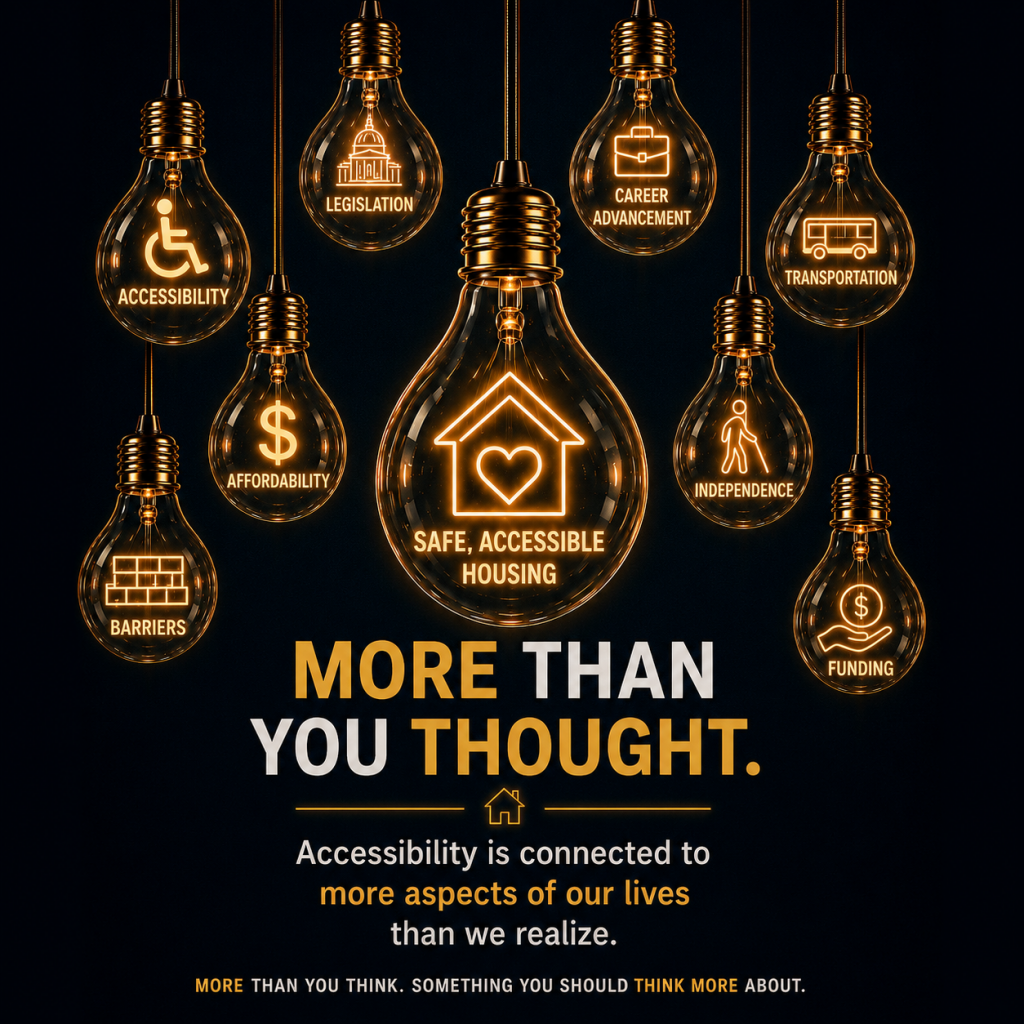
More Than You Thought: Reflecting on a Community Conversation About Accessibility
Over the past several months, our “More Than You Think. Something You Should Think More About.” awareness campaign invited our community to look beyond common assumptions about disability and accessible housing.
When the campaign began, our goal was simple: to encourage people to think differently and further.
Too often, accessibility is viewed as something that benefits only a small group of people. Accessible housing is often considered a specialized solution rather than an essential part of creating healthy, inclusive communities. We wanted to challenge those perceptions and start conversations about who accessibility is really for.
Throughout the campaign, we explored topics that demonstrated how accessibility reaches far beyond ramps, elevators, and building codes.
We highlighted how accessibility intersects with affordable housing, employment, transportation, healthcare, legislation, community planning, and everyday life. We shared stories that reflected the experiences of people living with disabilities, while also showing that disability can affect anyone through aging, injury, illness, caregiving, or unexpected changes in life.
One of the strongest messages that emerged was that accessibility is not about creating advantages. It is about removing barriers.
When homes are designed to be accessible from the beginning, people are better able to live independently, remain connected to their communities, pursue employment, raise families, and age in place with dignity. These benefits extend far beyond people who currently identify as having a disability. Accessible communities support parents pushing strollers, older adults, visitors recovering from surgery, delivery workers, caregivers, and anyone whose needs change over time.
Throughout the campaign, we also addressed common myths surrounding disability and accessible design. We explored misconceptions about who benefits from accessible housing, the realities that individuals with disabilities experience, what universal design looks like, the costs associated with accessibility, and why accessibility should never be considered an optional upgrade or an afterthought.
These conversations reinforced an important reality: accessibility benefits everyone.
Creating inclusive communities requires more than individual accommodations. When accessibility is integrated into housing, neighbourhoods, workplaces, transportation, and public spaces from the beginning, communities become stronger, more resilient, and more welcoming for everyone.
Although this campaign has come to an end, the conversation continues.
Accessible housing remains in short supply across Alberta and Canada. As our population ages and housing needs continue to evolve, accessibility will become increasingly important for all of us. Building inclusive communities requires ongoing collaboration between governments, housing providers, developers, businesses, and community members.
When we think differently, we build differently.
And when we build differently, we create communities where everyone has the opportunity to live safely, independently, and with dignity.
Because accessibility is more than you thought.
And it’s something we should all continue to think more about.