
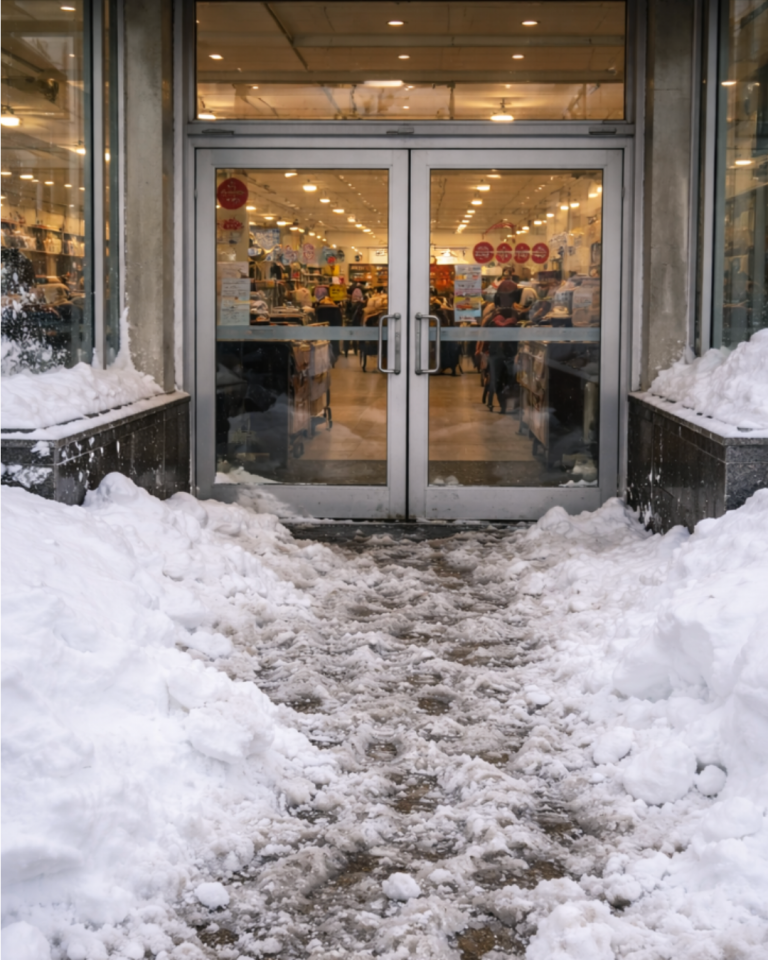
The Need for Accessibility Doesn’t End When It Snows
Yesterday’s massive snowstorm has left much of our city buried. While snow days can feel temporary and inconvenient for many, for people with physical disabilities, the lack of proper snow clearing at businesses creates something far more serious than inconvenience. It creates exclusion.
A viral reel shared by UrbaCalgary (Instagram) recently showed someone attempting to push a wheelchair user through deep, uncleared snow outside a large retail store in the city. The video sparked conversation across social media, but for many in the disability community, this wasn’t surprising. It was familiar.
Snow Is Not Just a Seasonal Nuisance — It’s a Barrier
When sidewalks, parking lots, curb aprons, ramps, and entrances are not cleared promptly and thoroughly, they become impassable.
For individuals who:
- Use wheelchairs or mobility scooters
- Rely on walkers or canes
- Have balance or endurance challenges
- Use assistive devices on wheels
Snow and ice transform everyday errands into impossible tasks.
Even with assistance, navigating thick, uneven snow can be dangerous. Pushing a wheelchair through slush and snow requires significant strength and control. The helper struggles to maintain traction. Wheels sink. Ramps become slippery. Curb aprons disappear under snowbanks. What should be a straightforward trip into a store becomes exhausting, unsafe, and often unsuccessful.
Anything on Wheels Is at Risk
Mobility devices are not designed for deep, uncleared snow. Small front casters can catch and stop abruptly. Power chairs can lose traction. Scooters can get stuck. Walkers slide. Canes sink.
And it’s not just mobility aids. Strollers, delivery carts, and even standard shopping carts struggle in poorly cleared spaces, but for someone whose independence depends on mobility equipment, the stakes are far higher.
The risk of:
- Falls
- Equipment damage
- Strain or injury to caregivers
- Being stranded in unsafe conditions
increases dramatically when snow removal is treated as optional.
Accessibility Is a Year-Round Responsibility
Accessible parking spots, curb cuts, ramps, and entrance pathways are only meaningful if they remain usable.
An accessible parking stall covered in snow is not accessible.
A ramp that leads to a snowbank is not accessible.
A sidewalk cleared only down the centre, leaving curb aprons blocked, is not accessible.
Snow removal is not just maintenance. It is access.
The Hidden Impact: Isolation
When snow creates physical barriers, it also creates social ones.
People may cancel appointments. Skip work. Miss social events. Avoid errands. Delay medical visits. The message, intentional or not, becomes clear: “You can wait.”
But accessibility cannot be seasonal. Independence cannot be weather-dependent.
This Is Preventable
This is not about extraordinary circumstances. Heavy snow is predictable in our climate. It happens every year. Preparation is possible. Planning is possible. Proper clearing is possible.
The viral reel was not about one store. It highlighted a systemic issue, one that resurfaces after every major snowfall.
If we are serious about inclusion, winter accessibility must be part of the conversation.
What Needs to Change
- Businesses must prioritize clearing accessible routes first — not last.
- Snow must be removed from access aisles and curb cuts, not piled into them.
- Clearing must happen promptly and be maintained throughout the day.
- Property managers must understand accessibility standards and winter obligations.
Accessible communities do not disappear when it snows.
Inclusion Means Clearing the Path
The conversation sparked by UrbaCalgary’s video should not fade as the snow melts. It should lead to action.
Accessibility is about removing barriers, not creating seasonal ones.
No one should have to risk injury or rely on extraordinary effort just to enter a store. And no caregiver should have to wrestle a wheelchair through a snowbank because basic maintenance wasn’t prioritized.
Snowstorms are unavoidable. Exclusion is not.
February 18, 2026